Cart
0
CVD vs. HPHT Lab-Grown Diamonds : Blog Summary
- Lab-grown diamonds are identical to mined diamonds in all properties.
- Two main methods: CVD and HPHT.
- HPHT mimics Earth’s pressure using metal catalysts.
- CVD grows diamonds layer-by-layer using carbon gas in a vacuum.
- Visually identical, but CVD offers better Type IIa purity.
- HPHT may show slight blue tint; CVD may show brown if low quality.
- Certification is the only reliable identification method.
- No fading or quality loss over time.
- CVD dominates large diamonds (1+ carat).
- Best choice: HPHT for small stones, CVD for solitaires.
As we navigate the high-jewelry landscape of 2026, the question is no longer whether a diamond is "real"—the science has long since settled that lab-grown diamonds are chemically, physically, and optically identical to their mined counterparts. Instead, the modern connoisseur is asking a more technical question: "CVD or HPHT?"
While both methods result in a 100% authentic diamond, the journey from carbon to crystal is vastly different for each. This guide serves as a comprehensive resource for understanding the technicalities, the aesthetics, and the financial reality of these two manufacturing marvels.

1. The Core Difference: How They Are Born
To understand which ring looks better or holds more value, we must first look at the "birth" of the stone.
HPHT (High Pressure High Temperature)
The HPHT method is the older of the two, designed to mimic the crushing pressure and searing heat of the Earth's mantle.
-
The Process: A small diamond "seed" is placed into a large press and subjected to temperatures of 1,500°C and pressures of roughly 1.5 million pounds per square inch.
-
The Catalyst: HPHT growth requires a molten metal flux (typically a mix of iron, nickel, and cobalt) to dissolve the carbon so it can precipitate onto the seed.
CVD (Chemical Vapor Deposition)
CVD is the "high-tech" descendant, often compared to 3D printing with light.
-
The Process: A diamond seed is placed in a vacuum chamber filled with carbon-rich gases (like methane). A microwave beam or plasma torch breaks the molecular bonds of the gas, causing pure carbon to rain down and crystallize onto the seed layer by layer.
-
The Purity: CVD diamonds grow in a gas environment without the need for molten metals.

2. Which Ring Looks Better?
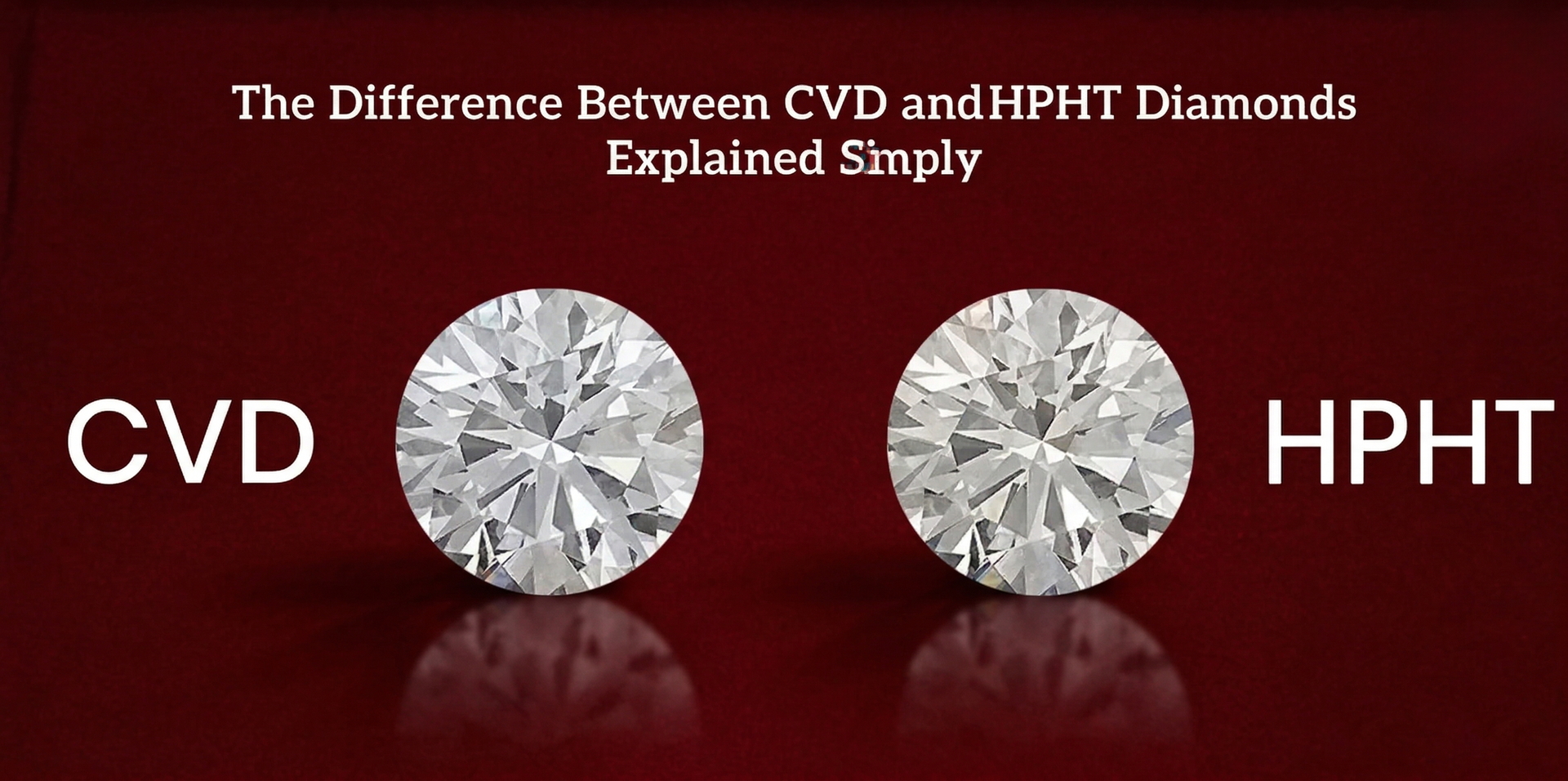
To the naked eye, a top-tier CVD diamond and a top-tier HPHT diamond are indistinguishable. Both can achieve the coveted "D" color and "VVS1" clarity. However, at a microscopic level, they possess different "genetic" markers that can affect their visual soul.
-
HPHT Visuals: Because they grow in a cuboctahedron shape (14 directions), HPHT stones can occasionally exhibit Blue Nuancing. This is a faint blue tint caused by the presence of boron used to accelerate growth. In 2026, high-end buyers often look for this to ensure the stone doesn't look "overly blue" in natural sunlight.
-
CVD Visuals: CVD diamonds grow in a flat, tabular shape (1 direction). While they don't have blue tinting, lower-quality CVD stones can sometimes show Brownish Tints or "grain lines" if the growth process was too fast.
The Verdict: If you are buying a Type IIa solitaire, CVD often has the "icier" and more transparent look because it lacks the metallic flux or boron found in many HPHT stones.

3. How to Know if a Friend's Ring is CVD or HPHT
If you are looking at a ring on someone’s finger, it is virtually impossible to tell the difference without lab equipment. However, here are the three ways professionals distinguish them:
-
The Certificate: This is the only 100% certain way. Check the IGI or GIA certificate; it will explicitly state "Laboratory Grown Diamond" and specify the "Growth Method: CVD" or "Growth Method: HPHT".
-
The Magnetism Test: Because HPHT diamonds use molten metal catalysts, some stones contain microscopic metallic inclusions. Very rarely, a high-carat HPHT stone might show a slight reaction to a powerful neodymium magnet. CVD diamonds are never magnetic.
-
Fluorescence Patterns: Under specialized UV light (like a DiamondView machine), HPHT diamonds show a "cross-like" growth pattern, while CVD diamonds show a "striated" or layered pattern.
4. The Resale Reality: Which One Has More "Return"?
In the 2026 market, the resale value of a lab-grown diamond is determined by its 4C grading and certification, not necessarily its growth method. However, there is a slight "liquidity" advantage for CVD.
-
Wholesale Demand: Many international wholesale vendors prefer CVD for large solitaires (2 carats and above) because it is seen as the "cleaner" technology.
-
Buyback Policies: Most reputable brands offer a 70% to 80% buyback on the prevailing market price. Because CVD stones often command a slightly higher market price due to their Type IIa purity, your absolute "return" in cash terms might be higher for a CVD stone.

5. Does the Quality "Vanish" or Fade Over Time?
There is a common myth that lab diamonds "cloud up" or lose their shine. This is scientifically impossible.
Both CVD and HPHT stones are 100% crystalline carbon. They have a hardness of 10 on the Mohs scale, exactly like mined diamonds.
-
Durability: Neither stone will ever change color, lose its clarity, or "fade".
-
Maintenance: If a Promise ring looks dull, it is almost certainly due to a buildup of oils, lotions, or dust on the pavilion (the bottom) of the stone. A professional cleaning will restore it to its original day-one brilliance.
6. The 11-Carat Question: Why CVD Dominates Large Stones
The user asked: Does CVD allow an 11-carat ring while HPHT doesn't?
While HPHT can theoretically grow large stones, it is technically much harder and riskier.
-
HPHT Limits: Growing a massive 10+ carat HPHT stone requires a massive press to maintain perfect, stable pressure for weeks. The risk of the stone cracking or becoming heavily included with metal is very high.
-
CVD Freedom: CVD growth is a "low pressure" environment. As long as the carbon gas is fed into the chamber and the plasma stays stable, the diamond can theoretically grow indefinitely. This is why most of the world’s record-breaking large lab diamonds—including monumental 10-carat plus solitaires—are grown using the CVD method.

7. Why the World is Moving Toward CVD
In 2026, we are seeing a significant shift in consumer preference toward CVD. The reasons are three-fold:
-
Chemical Purity: As mentioned, CVD is the gold standard for producing Type IIa diamonds, which contain the least amount of impurities.
-
Ethical Transparency: CVD reactors are often easier to run on renewable energy compared to the massive power draw of industrial HPHT presses.
-
Bespoke Shapes: CVD growth allows for larger "flat" plates, which are perfect for cutting modern elongated marquise or emerald cuts with perfect proportions.
8. A Word from the Founder: Hema Khatwani
"In the lab-grown industry, we are no longer just jewelers; we are gemological curators," says Hema Khatwani, Founder of The Ice Lane. "When I talk to the new generation of Gen Z buyers, I tell them: don't just buy a diamond for the certificate. Buy it for the 'Science of the Shine'. We prioritize CVD not because it’s easier—in fact, it’s a much more delicate process—but because it results in a Type IIa stone that has a visual soul. It represents the pinnacle of human achievement in 2026".
9. Final Advice for the 2026 Buyer
If you are choosing between the two for your infinity band or engagement ring, here is your 2026 cheat sheet:
-
Choose HPHT if: You are buying a ring with many small diamonds (melee). HPHT is highly efficient for producing thousands of tiny, perfectly round stones for sparkling tennis bracelets.
-
Choose CVD if: You are buying a Solitaire above 1 Carat. The clarity, the absence of blue nuancing, and the Type IIa purity make CVD the superior choice for a center stone that will be an heirloom.
No matter which path you choose, remember that you are purchasing a miracle of modern science. Whether born from pressure or from plasma, your diamond is a "forever" stone.
Chat with an expert on WhatsApp: +91 81078 88600
Ready to find a stone that’s worth every penny of the joy it brings?
Curious to Visit a Jewelry Exhibition we have covered IIJS Tritiya 2026 | Bangalore International Exhibition Centre (BIEC)
CVD vs. HPHT: Science & Style
What is the fundamental difference in how CVD and HPHT diamonds are grown?
HPHT (High Pressure High Temperature) mimics the Earth's mantle using extreme heat and pressure with a molten metal catalyst. CVD (Chemical Vapor Deposition) is a high-tech vacuum process where carbon-rich gases are broken down by plasma to crystallize pure carbon onto a seed layer by layer.
Why does CVD dominate the market for large diamonds (10ct+)?
HPHT growth is technically risky for massive stones due to the extreme pressure required, which often leads to cracking. CVD operates in a low-pressure environment where diamonds can theoretically grow indefinitely as long as the plasma stays stable, making it the preferred method for record-breaking solitaires.
How do visual "genetic markers" differ between the two methods?
HPHT stones may occasionally exhibit "Blue Nuancing" (a faint blue tint from boron), while lower-quality CVD stones can show brownish tints or grain lines if grown too quickly. However, Type IIa CVD diamonds are often considered "icier" because they lack metallic flux and boron.
Can you tell if a diamond is CVD or HPHT just by looking at a ring?
To the naked eye, it is virtually impossible. Professionals distinguish them by checking the IGI/GIA certificate, performing magnetism tests (as HPHT may have metallic inclusions), or viewing growth patterns under specialized UV light.
Is there a resale or liquidity advantage for one method over the other?
While value is primarily driven by the 4Cs, CVD often has a slight liquidity advantage for large solitaires (2ct+) because international wholesalers view it as a "cleaner" technology. This may lead to a higher absolute cash return in buyback scenarios.
Do lab diamonds ever lose their shine or "cloud up" over time?
No. Both CVD and HPHT diamonds are 100% crystalline carbon with a hardness of 10. They will never change color or fade; any dullness is typically just surface buildup that can be removed with a professional cleaning.