Cart
0
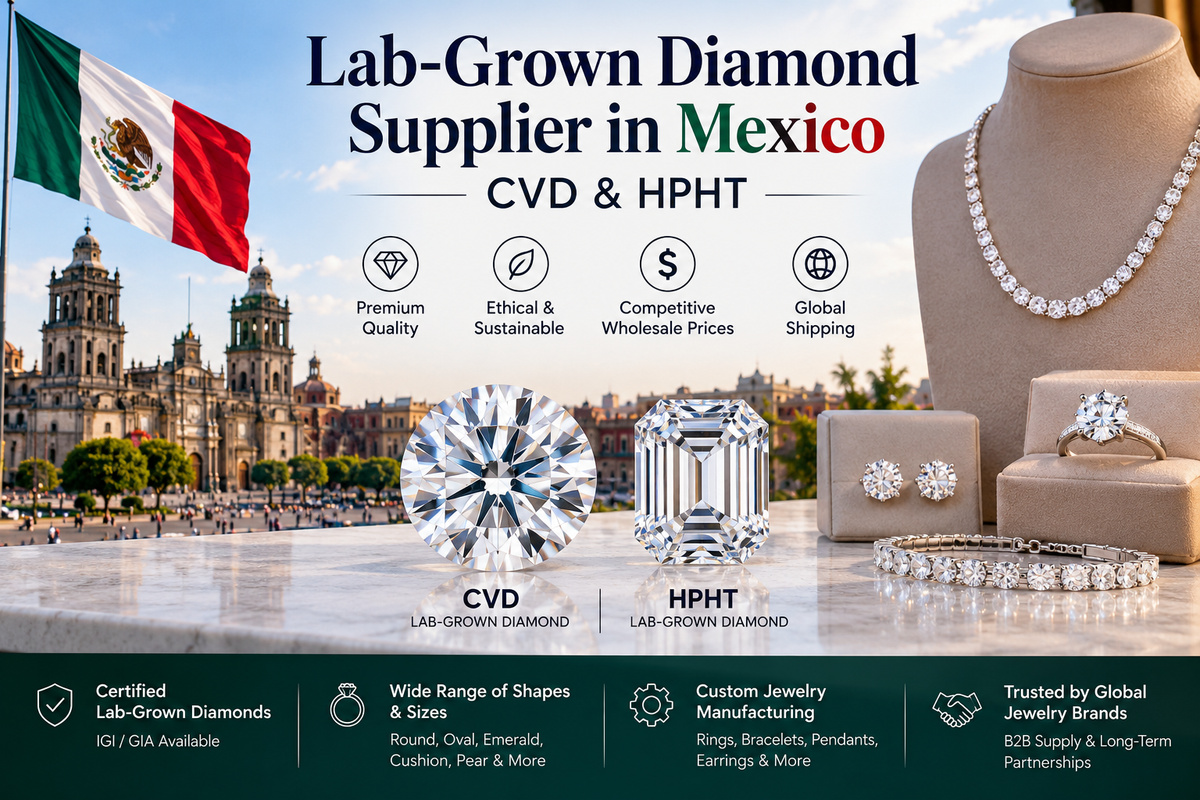
Mexico’s jewellery market is becoming more design-driven, value-aware, and globally connected, which means buyers need more than a basic stone list from a vendor. If you are searching for a lab-grown diamond supplier in Mexico, the real question is not simply CVD or HPHT—it is whether your supplier can deliver repeatable quality, dependable documentation, polished manufacturing support, and smooth cross-border fulfilment.
For retailers, independent jewellers, private-label brands, and sourcing teams, the smartest buying decision usually comes down to process. A supplier may offer attractive inventory on paper, but unless they can back it with grading reports, consistent matching, setting expertise, and export-ready coordination, your buying risk stays high.

What Mexico-based B2B buyers should evaluate first
When comparing overseas vendors, start with the fundamentals that affect resale confidence and operational ease in Mexico:
- Stone documentation: Ask what reports are available for individual solitaires and matched pairs or layouts.
- Quality consistency: Review how the supplier controls cut standards, colour ranges, and calibration across orders.
- Range across growth methods: A strong partner should explain suitable use cases for both CVD and HPHT goods instead of pushing one category for every requirement.
- Jewellery manufacturing capability: If you need finished pieces, evaluate setting quality, metal standards, CAD support, and production communication.
- Export preparedness: Clear packing lists, invoice accuracy, and responsive coordination matter as much as the stones themselves.
If your team is still comparing production methods at a high level, it helps to review CVD and HPHT buying essentials before locking a sourcing strategy.
CVD vs HPHT: think in terms of selling needs, not theory
For wholesale buyers in Mexico, the better choice is often driven by assortment planning. Bridal-focused retailers may prioritise round and fancy solitaires with tight matching parameters, while fashion-jewellery teams may need calibrated stones for repeated production runs. In both cases, what matters is how consistently the supplier can fulfil your required specifications over time.
CVD stones are often selected for broad solitaire programs and commercial jewellery lines where repeatability is important. HPHT may also have a place depending on shape, size range, or stock availability. The right supplier should help you build a practical mix instead of turning the purchase into a technical lecture.
That is especially useful when planning complete ring programs. A clean solitaire such as the three-claw round solitaire style shows how much cut precision and symmetry matter in a minimal setting, because there is very little metalwork to distract from the centre stone.
Certification is not a box to tick—it is part of your sales workflow
For Mexico retailers and jewellers, certification affects staff training, customer trust, and after-sales confidence. Ask your supplier how reports are mapped to shipped stones, how they handle memo images or videos, and whether they can maintain traceable order references from quotation to dispatch.
Good B2B support also means the supplier can present goods in a way your team can actually sell. That includes:
- Clear stone identifiers on invoices and packing records
- Consistent grading communication across reorders
- Visual references for centre stones used in finished jewellery
- Responsiveness if your quality-control team flags a mismatch
For buyers building a city or regional assortment strategy, browsing a retail-facing presentation like regional solitaire merchandising examples can also help you evaluate how products are positioned for end customers once they leave the sourcing stage.
Consistency matters more than one impressive sample
Many international suppliers can send one beautiful stone. Fewer can maintain the same make, spread, finish, and matching quality across repeated B2B orders. That is why Mexico buyers should test for consistency with small but specific trial orders before scaling.
Request a controlled assortment by shape, size, and grading range. For example, if princess cuts are important to your bridal category, compare matched inventory and completed ring execution, not only loose-stone lists. The princess trio bridal format is a useful reference because side-stone harmony is easy to judge visually.

Likewise, a dedicated category such as structured princess-cut ring assortment can reveal whether a supplier understands how one shape translates into multiple retail-ready designs rather than a one-off SKU.
Assess finished jewellery capability, not just stone supply
If your business imports complete jewellery, your supplier should be able to support more than stone selection. You want evidence of stable craftsmanship, secure setting work, polished finishing, and design versatility across solitaire, halo, bezel, and multi-stone formats.
Take bezel-set products as an example. A piece like the heart bezel solitaire profile depends on clean metal finishing and proportion control, not only centre-stone quality. That is the kind of style that tells you whether a manufacturing partner can execute softer contemporary aesthetics with precision.

Halo designs are another useful test because they expose alignment, seat work, and finishing standards. Reviewing a piece such as the round halo centre-stone showcase can help buyers assess whether the supplier can maintain visual balance in more intricate bridal settings.
Questions to ask an international supplier before placing a Mexico order
- Can you supply both loose stones and finished jewellery?
- Which shapes and size ranges are regularly available?
- How do you handle repeat orders for matched quality?
- Can you support bespoke CAD-based development for retail collections?
- What documentation travels with the shipment?
- How are timelines communicated for made-to-order pieces?
- Who manages export coordination and shipment status updates?
The best answers are usually specific and process-oriented. Vague promises around “top quality” or “best price” are far less useful than a clear explanation of grading workflow, production checkpoints, and dispatch documentation.
Build your vendor shortlist around reliability
When sourcing for Mexico, a dependable supplier should help reduce friction across your entire chain—from merchandising to customer delivery. That means they should be able to support:
- Retail assortment planning: Stones and designs aligned to your market segment
- Reorder confidence: Similar output across future purchase cycles
- Brand development: Capacity for signature settings or private-label execution
- Operational readiness: Export paperwork and communication that save your team time
In practice, many buyers find that a supplier with a broad retail design vocabulary is easier to work with on custom programs. For example, collections featuring refined solitaires, princess-cut bridal options, and halo settings suggest stronger readiness for varied briefs than a vendor limited to generic stock models.
Final takeaway for Mexico jewellery buyers
Choosing a lab-grown diamond supplier in Mexico is really about choosing a partner that can support your margins, your brand presentation, and your operational consistency. Compare CVD and HPHT where relevant, but put equal weight on certification flow, quality repeatability, finished-jewellery execution, and export support.
If you are refining your bridal or solitaire assortment, explore The Ice Lane’s lab-grown diamond collection for a clear view of design direction, product presentation, and ring formats suited to modern retail demand.
Lab-Grown Diamond Supplier in Mexico FAQs
How can I find a reliable lab-grown diamond supplier in Mexico?
To find a reliable lab-grown diamond supplier in Mexico, compare diamond quality, CVD and HPHT options, certification, wholesale pricing, shipping policies, and customization services. Request grading reports and verify supplier credentials before placing a bulk order.
Where can I buy wholesale CVD and HPHT lab-grown diamonds for my jewelry business in Mexico?
Jewelry retailers and wholesalers in Mexico can source CVD and HPHT lab-grown diamonds from international manufacturers and specialized B2B suppliers. The Ice Lane offers lab-grown diamond sourcing and jewelry options for businesses seeking wholesale supply and international shipping.
What is the difference between CVD and HPHT lab-grown diamonds?
CVD diamonds are grown layer by layer using carbon-rich gases in a controlled vacuum chamber, while HPHT diamonds are produced under high pressure and high temperature replicating geological conditions. Both methods create real diamonds, and their quality should be evaluated based on the 4Cs and available grading reports.
How can dropshippers start selling lab-grown diamond jewelry in Mexico?
Dropshippers can start by choosing a reliable supplier, selecting popular jewelry designs, establishing product pricing, and creating an online store. Before launching, confirm product availability, shipping times to Mexico, return policies, packaging options, and whether the supplier supports direct-to-customer fulfillment.
What certifications should I check when buying lab-grown diamonds wholesale?
Look for a grading report from a recognized gemological laboratory, such as IGI or GIA, where available. Verify the report number, diamond measurements, 4Cs, and laboratory-grown disclosure, and confirm that the report matches the actual stone via laser inscription.
When should a jewelry retailer choose CVD instead of HPHT diamonds?
A retailer should compare CVD and HPHT diamonds according to the required size, color, clarity, cut, budget, and customer preferences. Neither growth method automatically guarantees superior quality, so compare individual stones and their grading reports before purchasing.
How can I find affordable lab-grown diamond jewelry for dropshipping with international shipping to Mexico?
Compare B2B suppliers that offer competitive wholesale prices, a suitable product range, transparent shipping costs, and reliable fulfillment. Ask about minimum order quantities, high-resolution product imagery, inventory feeds, tracking, returns, and direct shipping to Mexican customers before selecting a partner.