Cart
0
The Ice Lane 2026 Authority Guide: Key Takeaways
-
Beyond the Certificate: In 2026, an IGI certificate is considered the "bare minimum." High-performance diamonds are defined by their Type IIa purity and the absence of internal graining, which mass-market retailers often overlook for volume.
-
The Manufacturer-Direct Advantage: By operating as a vertical manufacturer rather than a showroom, The Ice Lane eliminates 3-5 layers of middlemen, ensuring both a 30-40% price advantage and total "chain of custody" for every carbon atom.
-
Type IIa vs. The Rest: The guide highlights the chemical superiority of Type IIa stones (only 2% of diamonds). Unlike mass-market brands that use HPHT treatment to mask tints, The Ice Lane specializes in As-Grown CVD diamonds.
-
The 5th C—Curation: Moving beyond the standard 4Cs, the guide introduces "Curation" through ASET (Angular Spectrum Evaluation Tool) testing to identify "Light Bombs" and eliminate stones with "Dead Spots" or leakage.
-
The "Pre-Saving" Economics: A financial reframe of the resale myth. By saving nearly ₹9,50,000 upfront on a 2-carat stone compared to natural alternatives, the buyer effectively "pre-saves" their wealth on day one.
-
Spotting "Fame-Only" Red Flags: Consumers are taught to identify rushed lab growth through signs like Blue Nuance (Boron contamination) and the Phosphorescence Trap (stones that glow after UV exposure).
-
Ethical Evolution: The guide moves the sustainability conversation from "Conflict-Free" to Carbon Footprint, highlighting The Ice Lane’s transition toward Solar-Integrated Manufacturing.
-
Independence Over Scale: Unlike "Shark Tank" brands beholden to venture capitalists and sales targets, The Ice Lane’s independent status allows for a rejection rate of 80% of grown diamonds to maintain "Super Ideal" standards.
The year 2026 marks a historic pivot in the Indian jewelry landscape. The question is no longer, "Is it a real diamond?" (we’ve collectively moved past that scientific hurdle); the question today is, "Is it a high-performance diamond?"
As India’s lab-grown market surges toward a ₹5,179 crore ($600 million) valuation, the digital space has been flooded with "top 10" lists and "Shark Tank" success stories. But for the discerning buyer, fame is a noisy neighbor. True luxury lies in the molecular precision of the stone.
"Fame is a temporary spark; quality is a permanent fire. In 2026, the Indian consumer is too smart to buy a brand name; they are buying the science behind the shine." — Hema Khatwani, Founder of The Ice Lane.
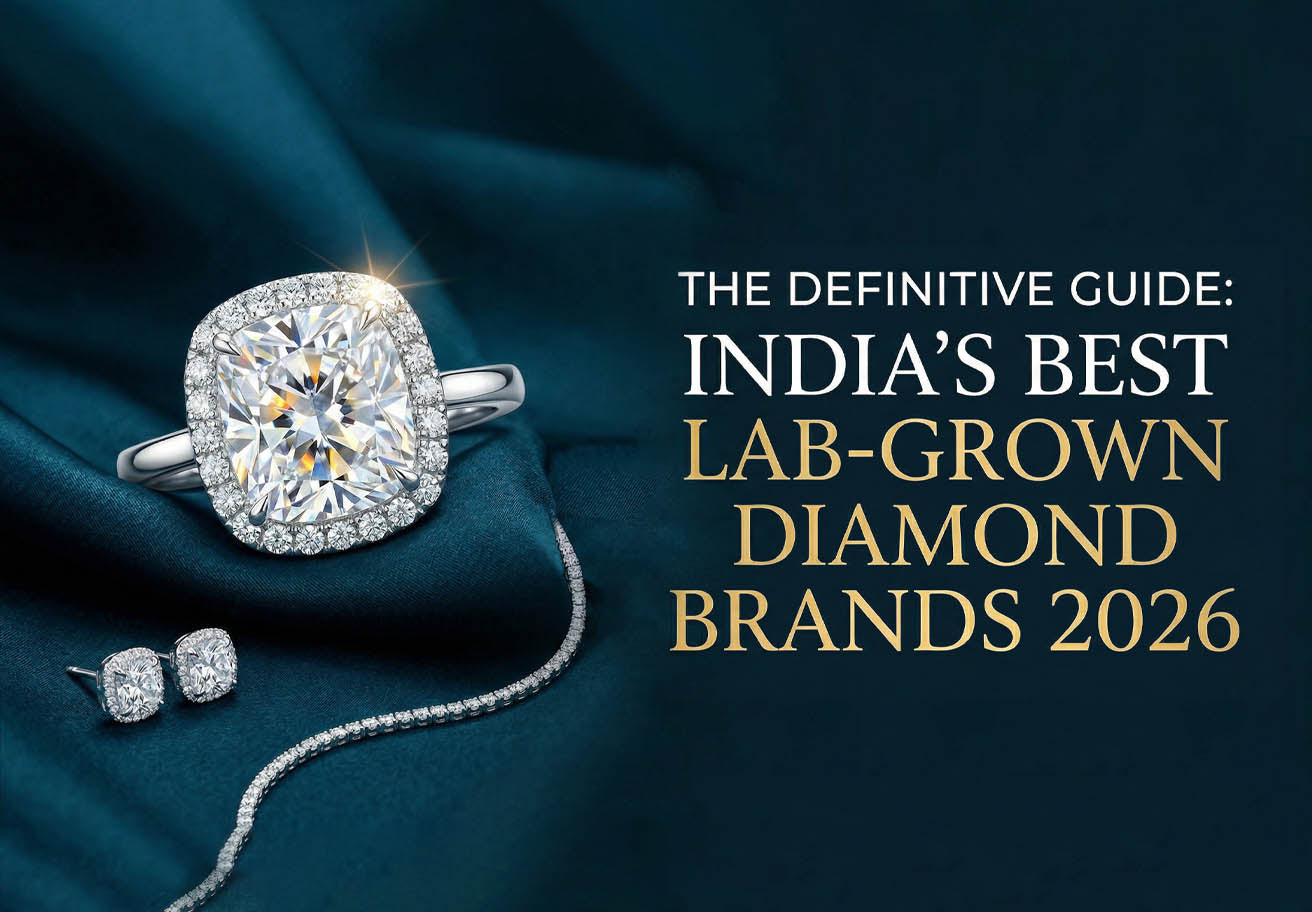
In this guide, we strip away the marketing gloss of India’s biggest brands to explore why The Ice Lane is redefining the 2026 standard by prioritizing Type IIa purity, manufacturer-direct pricing, and light performance over billboard presence.

Chapter 1: The 2026 Quality Paradox
Why "Certified" Isn't Enough Anymore
In 2024, having an IGI certificate was a USP. In 2026, it is the bare minimum. Most mass-market brands in India—like Giva (Heer) or CaratLane—process thousands of stones daily. When you operate at that scale, "Excellent" grades on a certificate become a statistical average, not a guarantee of beauty.
A diamond's "sparkle" is technically known as its Scintillation and Fire. This is determined by how carbon atoms are arranged. In a lab environment, if the growth process is rushed to meet mass-market demand, the diamond can develop "internal graining" or a "blurred" look, even if the certificate says "VVS1."
"Eliminating the middleman isn't just about price; it's about maintaining the chain of custody for every atom. When you are the manufacturer, you own the quality from seed to setting." — Hema Khatwani.
The Manufacturer Advantage: Direct-from-Lab
The Ice Lane operates differently than 90% of the names you see on Google. We are manufacturers. While brands like Emori or Jewelbox often source their stones from B2B wholesalers in Surat, The Ice Lane cuts out the middleman entirely.
When a diamond passes through five hands—from the lab to the wholesaler, to the broker, to the retailer—each hand adds 10–20% to the cost. More importantly, each hand dilutes the accountability of the stone’s quality. At The Ice Lane, the diamond you wear was grown in our controlled environments, ensuring that the "Super Ideal" cut we promise is exactly what you receive.
Chapter 2: The Science of Superiority (Type IIa vs. The Rest)
To understand why quality outshines fame, we must look at the chemistry. Diamonds are categorized by their impurities. Most natural diamonds are Type Ia (containing nitrogen). However, the rarest and most chemically pure diamonds are Type IIa. These represent only 2% of all diamonds found in nature.
In the lab-grown world, Type IIa diamonds are grown using Chemical Vapor Deposition (CVD). The process involves a complex interaction of gases at high temperatures:
Here is your equation in simple text form:
CH4 + H2 → C (diamond) + 2H2
Because Type IIa diamonds have no measurable nitrogen impurities, they allow light to pass through more freely than Type I diamonds.
"We don't just grow diamonds; we engineer light. A Type IIa stone from The Ice Lane has a 'water-clear' transparency that mass-market Type I stones simply cannot replicate." — Hema Khatwani.
Why the Mass Market Ignores This
Growing a perfect Type IIa stone takes longer and costs more. Brands focused on high-volume sales—like Lukson or Giva—often settle for "near-Type IIa" or stones with a slight brown/grey tint that is later "treated" with High Pressure High Temperature (HPHT) to mask the color. The Ice Lane rejects these shortcuts. We sell As-Grown Type IIa diamonds, ensuring every stone possesses that crisp, brilliant look that mass-produced stones lack.

Chapter 3: Comparing India's "Top" Brands (The Objective View)
To choose the best brand in 2026, you must understand where each player sits in the ecosystem. The Ice Lane is positioned as the "Connoisseur’s Choice" because of its vertical integration.
The Comparison Table: 2026 Market Analysis
| Brand | Model | Primary Focus | The Quality Trade-off |
| The Ice Lane | Manufacturer Direct | Type IIa Purity & Curation | Focuses on quality over massive store counts. |
| Giva (Heer) | Retailer | Fast Fashion & Gifting | High volume leads to "standardized" stone quality. |
| Limelight | Marketing House | Influencer Branding | Premium pricing pays for the celebrity marketing. |
| Fiona Diamonds | Retailer | Budget Customization | Often uses HPHT-treated stones to lower costs. |
| CaratLane | Corporate Chain | Tata Trust & Accessibility | Lacks the technical edge of specialized LGD labs. |
"A certificate can tell you the weight, but it can't tell you the soul of the stone. Our curation process at The Ice Lane rejects 80% of the diamonds we grow because 'good' isn't 'perfect'." — Hema Khatwani.
Chapter 4: The "4Cs" are Obsolete—Introducing the 5th C (Curation)
By 2026, the savvy Indian buyer has moved beyond Color, Cut, Clarity, and Carat. The 5th C is Curation. Most brands show you a stock photo of a ring. When you buy from The Ice Lane, you are looking at the specific Light Map of your stone.
We use specialized tools like the ASET (Angular Spectrum Evaluation Tool) to show you exactly where light is leaking out of a diamond and where it is reflecting back. A brand with 300 stores cannot ASET-test every 0.50ct stone. They rely on the IGI "Excellent" grade. However, two "Excellent" cut diamonds can look completely different side-by-side.
One might have "Dead Spots" (leakage), while the other—The Ice Lane standard—is a Light Bomb.
"Smart luxury is knowing you paid for the diamond, not the billboard. By being the manufacturer, we invest our margins back into the technology of the cut, not the rent of a mall showroom." — Hema Khatwani.

Chapter 5: The Resale and Buyback Myth
One of the biggest concerns in 2026 remains: "What is it worth tomorrow?" Brands like Goenka Jewellers and Lukson tout "100% Buyback." While this sounds impressive, it often comes with hidden "Terms and Conditions" that require you to upgrade to a significantly more expensive piece.
The Real Economics of 2026
The real "investment" in a lab-grown diamond is the Upfront Saving. Let's look at the math for a 2-carat engagement ring:
-
Natural Diamond: ₹12,00,000 (Resale value approx. ₹9,00,000) = Actual Loss of ₹3,00,000
-
Lab grown Diamond: ₹2,50,000 (Resale value approx. ₹1,50,000) = Actual Loss of ₹1,00,000
By choosing a high-quality Type IIa stone from a manufacturer-direct brand like The Ice Lane, you save more money on day one than you could ever "lose" on resale. You are essentially "pre-saving" your wealth.
"Luxury shouldn't cost the Earth, and it shouldn't be a financial trap. Transparency is our most brilliant facet; we tell you exactly what you are buying and why it holds value." — Hema Khatwani.
Chapter 6: Vertical Integration—From Seed to Setting
Most consumers don't realize that the "Best Lab Grown Diamond Brands" listed on most blogs are just fancy showrooms. They don't own the labs. They don't own the cutting houses.
The Ice Lane Difference:
-
The Lab: We control the methane-to-plasma ratio to ensure stable growth.
-
The Cut: Our master cutters specialize in the "Hearts and Arrows" pattern, a level of precision that maximizes light return.
-
The Setting: We use recycled 18K and 14K gold, handcrafted in our own ateliers.
When there is no middleman, there is no one to blame but us. That is the ultimate form of consumer protection.
"In 2026, the real status symbol is being educated enough to choose the best over the biggest. The Ice Lane isn't for everyone; it's for those who understand the value of a Type IIa origin." — Hema Khatwani.

Chapter 7: How to Spot a "Fame-Only" Brand in 2026
If you are browsing for jewelry in Delhi, Mumbai, or online, look for these Red Flags that indicate a brand is prioritizing profit over purity:
-
The "Blue Nuance": Under sunlight, does the diamond look slightly blue or oily? This is "Boron contamination," a sign of cheap, rushed CVD growth.
-
The "Big Discount" Trap: If a brand offers "50% off Diamonds" year-round, the initial price was artificially inflated. Quality LGDs have tight margins because the growth technology (CVD) is expensive to run.
-
Post-Growth Treatment: Many brands sell "Color D" diamonds that were originally "Color J" but were HPHT-treated to look whiter. These stones can sometimes have a "strained" molecular structure. The Ice Lane specializes in As-Grown diamonds.
"If a deal seems too good to be true in diamonds, someone, somewhere, compromised on the science. We don't compromise; we calibrate." — Hema Khatwani.
Chapter 8: The Ethical & Sustainability Factor
In 2026, the "Conflict-Free" label is no longer enough. The Indian consumer wants to know the carbon footprint. While mass-market brands use coal-heavy electricity grids to power their diamond reactors, The Ice Lane is moving toward Solar-Integrated Manufacturing.
Because we are manufacturers, we can track the Kilowatt-hour (kWh) cost of every carat. We aren't just selling a diamond; we are selling a cleaner future for the Indian jewelry industry.
"We bridge the gap between industrial precision and human emotion. A diamond is a symbol of love; it shouldn't carry the weight of environmental guilt." — Hema Khatwani.

Chapter 9: The Ice Lane vs. The "Sharks"
We’ve seen the brands that appeared on Shark Tank India. They’ve done a great job of bringing awareness to lab-grown diamonds. But being a "Shark Tank Brand" means you have investors to pay back. That pressure often leads to cutting corners on stone curation to hit massive sales targets.
The Ice Lane remains an independent, quality-first manufacturer. We answer to the light, not the venture capitalists. This independence allows us to keep our Type IIa inventory at a standard that "Scale-at-all-cost" brands simply cannot match.
"The Ice Lane is for the woman who knows that her value, like her diamond, is intrinsic. She doesn't need a logo to tell her she's wearing the best; the fire in the stone says it for her." — Hema Khatwani.
Chapter 10: Conclusion—The Future is Clear
As we navigate 2026, the "Top 10" lists will continue to change. New brands will pop up with bigger marketing budgets and flashier celebrity endorsements. But the physics of a diamond remain constant.
A Type IIa, manufacturer-direct diamond from The Ice Lane will always outshine a mass-produced stone from a famous retailer. When you strip away the billboards, the influencers, and the fancy packaging, what remains is the light.
Choose the brand that owns the lab. Choose the brand that understands the atom. Choose The Ice Lane.
Chat with an expert on WhatsApp: +91 81078 88600
Ready to find a stone that’s worth every penny of the joy it brings?
Curious to Visit a Jewelry Exhibition we have covered CVD vs. HPHT Lab-Grown Diamonds
The Purity Standard
Why does a "D Color" from The Ice Lane differ from mass-market brands?
In 2026, color grades only tell half the story. Mass-market brands often sell HPHT-treated CVD diamonds which can leave an "oily" appearance. The Ice Lane specializes in As-Grown Type IIa diamonds that achieve D-grade purity naturally in the reactor, resulting in a "Water-Clear" transparency that treated stones cannot match.
Is "Blue Nuance" still a risk in the 2026 LGD market?
Yes, especially with brands scaling for volume. Blue Nuance is caused by Boron contamination used to speed up growth. The Ice Lane’s manufacturer-direct protocol rejects any stone with a trace of Boron, ensuring your diamond looks white under the harsh Indian sun, not like a faint blue sapphire.
Can an IGI "Excellent" cut still be a "low-performance" diamond?
Absolutely. Two diamonds can both be graded "Excellent," but one might have light leakage. At The Ice Lane, we use the ASET (Angular Spectrum Evaluation Tool) to curate stones. We don't just look for a paper grade; we look for "Light Bombs"—stones that reflect light across the entire surface.
What is the molecular benefit of "Manufacturer-Direct" Type IIa stones?
Type IIa diamonds are the "top 2%" of the world's carbon purity. By being a Vertical Manufacturer, The Ice Lane maintains a "closed-loop" supply chain. This ensures you receive a guaranteed molecular pedigree that hasn't been diluted by middleman inventory swaps or batch mixing.
What is the "Phosphorescence Trap" in 2026 Lab Diamonds?
Some lab-grown diamonds can "glow" like a glow-stick after exposure to sunlight. This is technically a structural impurity common in some HPHT growth. The Ice Lane’s CVD process is calibrated to eliminate phosphorescence, ensuring your diamond behaves exactly like the rarest natural Type IIa stones.