Cart
0
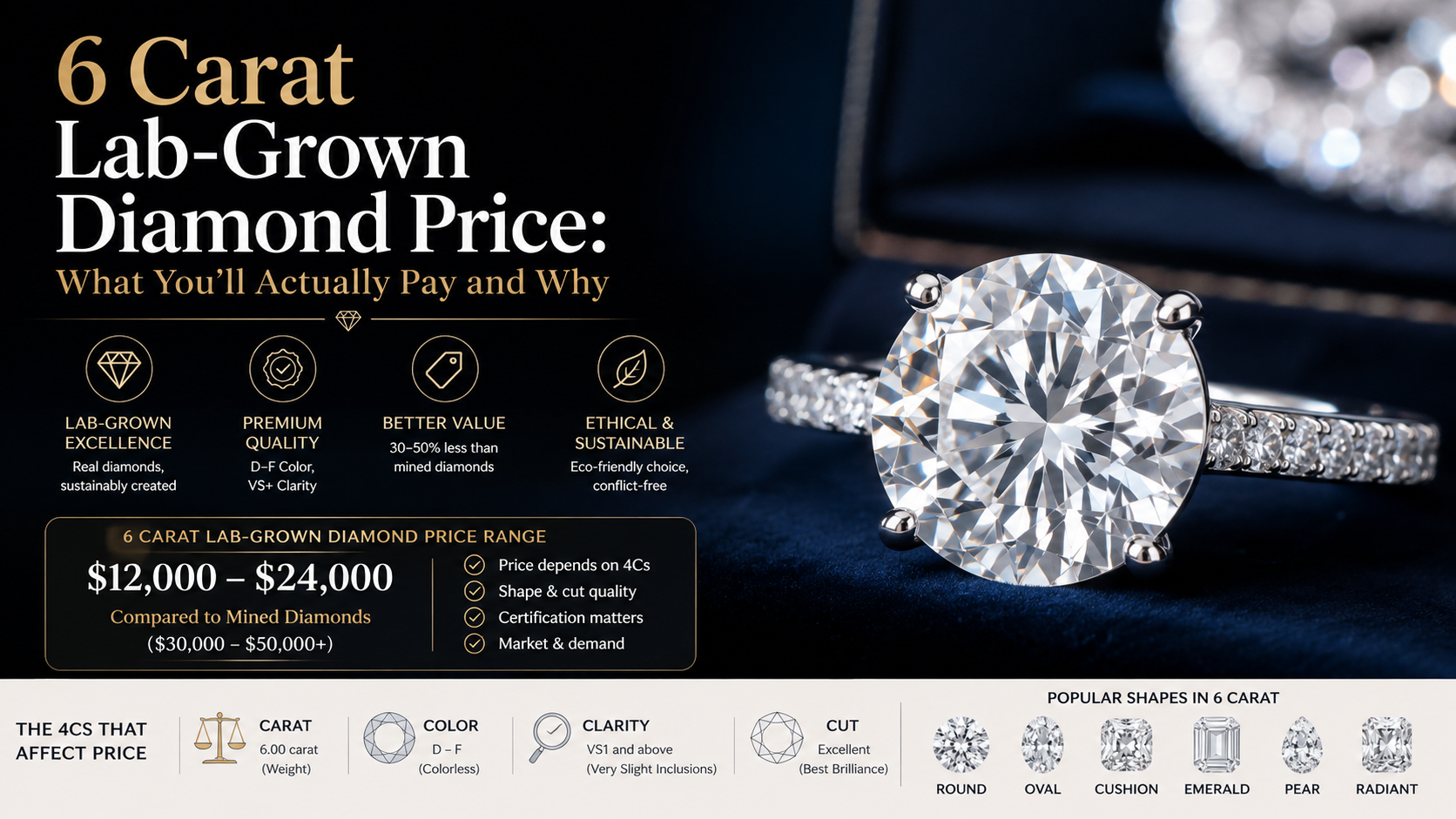
What does a 6 carat lab-grown diamond actually cost right now? Depending on cut, clarity, colour, and growth method, you're looking at roughly ₹4,50,000–₹12,00,000 in India (approximately $5,500–$14,500 USD) — a fraction of what an equivalent mined stone would command at auction.
That price gap is real, repeatable, and worth understanding before you walk into any showroom or open any vendor tab.

The Real Price Range for a 6 Carat Lab-Grown Diamond
A 6 carat stone sits in rarefied air. At this size, every quality variable — cut grade, colour rating, clarity grade, and growth process — has an outsized effect on price. The range isn't a small band; it's nearly a 3× spread between a well-cut VS2/G stone and a top-tier Excellent/Ideal-cut D/IF specimen.
Here's how the variables stack up across the most common configurations buyers actually purchase:
| Quality Profile | Cut Grade | Colour / Clarity | Estimated India Price (INR) | Est. USD Price |
|---|---|---|---|---|
| Entry commercial | Good–Very Good | J–K / SI2–I1 | ₹4,50,000–₹5,50,000 | $5,500–$6,800 |
| Mid-range preferred | Very Good | H–I / VS1–VS2 | ₹6,00,000–₹8,50,000 | $7,200–$10,300 |
| Premium solitaire | Excellent | F–G / VVS2–VS1 | ₹8,50,000–₹10,50,000 | $10,200–$12,700 |
| Collector grade | Ideal / Triple-Ex | D–E / VVS1–IF | ₹10,50,000–₹12,50,000+ | $12,700–$15,200+ |
Note: Prices reflect loose lab-grown diamonds and will shift ±15% depending on the vendor's overhead structure and whether the stone is CVD or HPHT grown.
The lab-grown diamond market was valued at $24 billion in 2023. — Grand View Research
CVD vs. HPHT: The Growth Method Changes Your Price Logic

Most 6 carat lab diamonds in today's market are grown via one of two processes:
- CVD (Chemical Vapour Deposition): Carbon-rich gas is ionised in a plasma reactor at around 900–1,200°C. Growth is slower, producing larger plates; post-growth HPHT annealing is often used to remove residual brown tinting. CVD stones at 6ct tend to carry slightly lower per-carat premiums.
- HPHT (High Pressure High Temperature): Replicates Earth's natural growth conditions — pressures of 5–6 GPa and temperatures of 1,300–1,600°C. HPHT-grown 6 carat stones at D-colour / IF clarity are rarer and command a premium for their Type IIa purity characteristics.
For most buyers selecting a 6 carat stone for an engagement ring or statement piece, CVD at VVS2–VS1 clarity is the sweet spot: excellent light performance at a per-carat cost of roughly ₹1,00,000–₹1,60,000, versus ₹1,60,000–₹2,00,000 for a comparable HPHT D-colour stone.
If you're comparing smaller stones before stepping up in carat, a breakdown of how 5 carat lab-grown diamond pricing scales gives useful context on where the per-carat cost curve flattens.
What Affects 6 Carat Lab Diamond Pricing Beyond the 4Cs
The 4Cs are the foundation, but at 6 carats, four additional variables move price more than most buyers expect:
- Fluorescence: Strong blue fluorescence can reduce price by 8–15% on an otherwise excellent stone — and at 6ct, that's a meaningful discount worth exploiting if you're buying daylight-facing cuts like round brilliants or ovals.
- Cut precision tolerances: An Excellent-cut round brilliant at 6ct should carry a table percentage of 54–57%, depth percentage of 61–62.5%, and crown angle of 34–35°. Stones that stray outside these tolerances lose fire despite identical clarity grades.
- Grading lab: GIA, IGI, and GCAL reports are the three labs worth trusting at this size. IGI is most common in India for lab-grown stones; GIA lab-grown reports are rarer but carry a slight secondary-market premium.
- Girdle finish: At 6ct, a bruted (unpolished) girdle can affect how light exits the pavilion. Faceted or polished girdles are worth asking for explicitly.
- Symmetry grade: Excellent symmetry is non-negotiable at this size. Poor symmetry creates visible "dead zones" in the stone's light pattern that no colour grade can compensate for.
📊 Lab-grown diamond retail prices dropped 10% in 2022, wholesale by 15%. — Bain & Company
Round Brilliant vs. Fancy Shapes at 6 Carats — Which Costs More?
Shape choice at 6 carats is a significant pricing lever, not just an aesthetic preference.
Round brilliant cuts require the most rough material and the highest cutting skill to achieve ideal light return — which means they command a 15–25% premium over most fancy shapes at equivalent quality.
Price comparison by shape (6ct, F–G / VS2, Excellent cut):
| Shape | Est. India Price (INR) | Why the Difference |
|---|---|---|
| Round Brilliant | ₹9,50,000–₹11,00,000 | Highest rough yield loss; premium cut grade demand |
| Oval | ₹7,80,000–₹9,50,000 | Lower rough waste; "bowtie" effect manageable with ideal proportions |
| Cushion | ₹7,00,000–₹8,80,000 | Forgiving on minor inclusions; popular in halo designs |
| Emerald Cut | ₹7,50,000–₹9,00,000 | Step facets expose inclusions — clarity grade matters more here |
| Radiant | ₹7,20,000–₹8,50,000 | Best brilliance-to-price ratio in the fancy-shape category |
If maximising visual size is a priority, oval and elongated cushion cuts appear physically larger face-up than round brilliants at equivalent carat weight — worth knowing when you're working with a specific budget ceiling.
📊 40% of US consumers (18-34) considered buying lab-grown diamonds in 2023. — Statista
Where to Buy a 6 Carat Lab-Grown Diamond in India

The vendor decision matters as much as the stone grade. At this budget level, you should expect:
- A grading certificate from GIA, IGI, or GCAL (not a house certificate)
- Full disclosure of the growth method (CVD or HPHT) on the invoice
- A written return or exchange window of at least 14 days
- The ability to view an ASET (Angular Spectrum Evaluation Tool) image or idealscope image for cut verification
Brands like Theicelane, which operate with manufacturing control out of Jaipur and focus on certified lab-grown inventory, are worth comparing specifically because they can disclose growth method, provide IGI-certified stones, and handle custom settings — versus grey-market resellers who may not itemise what you're actually paying for.
For engagement ring settings to pair with a 6 carat centre stone, browsing lab-grown diamond solitaire ring configurations gives a practical starting point for understanding how prong style, metal weight, and band profile affect the total build cost.
📊 Lab-grown diamonds held 18% of the global polished diamond market by value in 2022. — Bain & Company
The Per-Carat Math: Why 6 Carats Isn't Just 6× the 1 Carat Price
This is the part most buyers miss. Lab-grown diamond pricing is not linear.
A 1 carat lab-grown diamond in India might cost ₹50,000–₹80,000. Multiply that by 6 and you'd expect ₹3,00,000–₹4,80,000. The actual range starts at ₹4,50,000 and stretches well past ₹10,00,000. Why?
- Reactor time: Growing a 6ct rough takes significantly longer than growing six 1ct roughs — exponentially more controlled environment hours.
- Yield loss in cutting: The larger the rough, the more precise the planning required. Errors are costly and irreversible.
- Rarity even in lab supply: True 6ct+ lab-grown roughs that achieve Excellent cut grades with VVS clarity are not abundant — supply is smaller than demand at this tier.
For buyers who want to understand how this pricing curve develops before committing at 6 carats, reading through the 2 carat lab-grown diamond pricing guide for 2026 helps illustrate the progression logic clearly.
Setting a 6 Carat Stone: Metal and Design Considerations
A 6 carat lab diamond weighs approximately 1.2 grams on its own. The setting must be proportionate.

- Four-prong vs. six-prong: Six-prong settings are structurally recommended for stones above 4 carats — the additional contact points reduce stone movement and protect the girdle.
- Metal choice: 18K yellow gold or 18K white gold are the standard for fine settings at this size. Platinum (950 Pt) adds cost but gives superior prong hardness — a meaningful factor when a stone of this value is worn daily.
- CNC prong-setting: Precision-machined prongs (rather than hand-bent wax-cast prongs) maintain more consistent stone security at the 0.2mm tolerance range. Ask vendors specifically whether settings are cast or CNC-machined.
📊 The lab-grown diamond market will reach $36.6 billion by 2026. — The Business Research Company
For buyers considering a lab-grown diamond engagement ring with a 6 carat centre stone, the setting build cost typically adds ₹40,000–₹1,20,000 depending on metal weight and complexity.
What Smart Buyers Should Do Before Finalising a Purchase
Before transferring payment on a 6 carat lab-grown diamond, run through this checklist:
- Confirm the IGI or GIA certificate number matches the laser inscription on the stone's girdle under 10× loupe.
- Request the growth method in writing — CVD or HPHT — on the final invoice, not just verbally.
- Ask for fluorescence grade explicitly if the grading report is older than 6 months.
- View the stone in at least two lighting conditions: direct LED (spot) lighting and diffused natural daylight.
- Get the after-sale terms — exchange policy, resizing, and repolishing eligibility — in writing before paying.
Theicelane, for reference, provides IGI-certified lab-grown stones with disclosed growth method on all documentation — a baseline that too many casual resellers still fail to meet.
A 6 carat lab-grown diamond is one of the most striking purchases in the fine jewellery space. Get the certificate right, understand your growth method, and choose a setting built for the stone's weight — and you'll have a piece that performs and holds meaning for decades.
6-Carat Diamond FAQs
How much does a 6-carat lab-grown diamond cost in India?
A 6-carat lab-grown diamond in India typically ranges from around ₹4.5 lakh to ₹12.5 lakh+, depending on cut, colour, clarity, growth method, certification, and shape.
What affects the price of a 6-carat lab-grown diamond?
The main factors are the 4Cs—carat, cut, colour, and clarity—along with the CVD or HPHT growth method, grading laboratory, fluorescence, symmetry, girdle finish, and diamond shape.
Is CVD or HPHT better for a 6-carat lab-grown diamond?
Neither is universally better. CVD can offer strong value at larger sizes, while high-quality HPHT diamonds can command a premium, particularly for D-colour and IF-clarity stones. The individual diamond's quality and certification are more important than the growth method alone.
Which diamond shape is most affordable at 6 carats?
Fancy shapes such as oval, cushion, emerald, and radiant generally cost less than a comparable round brilliant. Round diamonds often command a premium because of higher rough-material loss and cutting requirements.
What certification should I look for when buying a 6-carat lab-grown diamond?
For a purchase at this size, look for a recognized grading report from IGI, GIA, or GCAL. Always verify that the certificate number matches the diamond's laser inscription and that the growth method is clearly disclosed.
What should I check before buying a 6-carat lab-grown diamond?
Before paying, confirm the grading certificate, CVD/HPHT growth method, fluorescence, cut quality, symmetry, return or exchange terms, and after-sales support. Viewing the diamond under different lighting conditions and requesting ASET or IdealScope images can also help assess its light performance.